
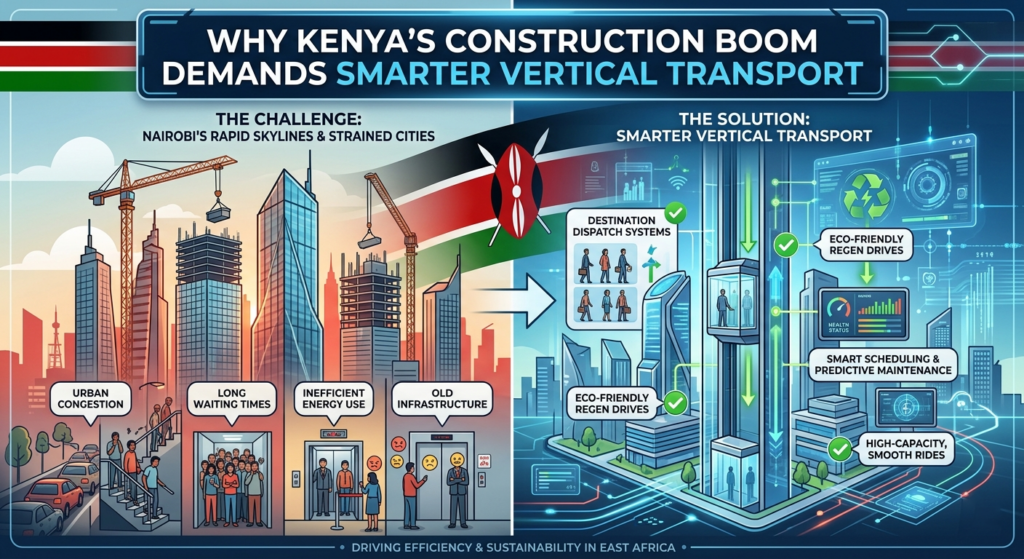
Drive along Waiyaki Way at dusk and you’ll see it, a skyline that didn’t exist a decade ago, now lit floor by floor against the Nairobi sky. Cranes pivot over Upper Hill. Glass towers catch the last sun in Westlands. New apartment blocks climb steadily above Kilimani and Kileleshwa. Kenya isn’t just building it’s building up, and that single shift in direction is quietly creating one of the country’s most overlooked infrastructure challenges: how do you move people safely, quickly and reliably through buildings that keep getting taller?
A Sector on the Rise Literally
The numbers tell the story plainly. Kenya’s construction sector rebounded sharply in 2025, expanding by 5.7% in the second quarter alone, a dramatic turnaround from the contraction recorded the year before. Cement consumption, the rawest proxy for building activity, jumped nearly 24% year on year. Analysts now expect the construction market to grow by roughly 7.5% in 2026, pushing its value above KES 1 trillion, with steady annual growth projected through the rest of the decade.
This isn’t a blip. It’s the visible result of a deliberate national push. Kenya’s Vision 2030 blueprint, the Bottom Up Economic Transformation Agenda, and an ambitious affordable housing programme have all converged to direct capital toward vertical development because in cities where land is scarce and increasingly expensive, building upward is the only way to house a growing population, expand office capacity, and accommodate the retail and hospitality footprint that a modern economy demands. Government budget allocations for infrastructure, energy and housing have climbed in tandem, while domestic credit flowing into construction grew by more than 17% in 2025 alone.
Nairobi is the most obvious face of this transformation, but the trend has legs well beyond the capital. Mombasa and Kisumu are both seeing renewed investor interest, with industry players describing Kisumu in particular as a coming focal point for the regional economy as infrastructure and trade routes mature.
What Gets Lost in the Skyline Conversation
Most coverage of Kenya’s building boom focuses on the visible parts the glass facades, the architectural firsts, the ribbon cutting ceremonies with government officials in attendance. Far less attention goes to the systems that make a tall building actually livable: power resilience, fire safety, water systems, and critically vertical transport.
An elevator is not a luxury fitting bolted on at the end of a project. In any structure beyond a few storeys, it is the building’s circulatory system. A hospital tower without dependable lifts cannot move patients on stretchers. A residential block without dependable lifts becomes inaccessible to elderly residents, parents with prams, or anyone with mobility challenges. A 40 storey office tower without dependable lifts simply does not function as an office tower it becomes 40 storeys of stranded square footage.
And Kenya’s vertical transport challenge has a distinctly local flavour. Power supply, while much improved, still fluctuates in ways that can strand a poorly engineered lift mid shaft. Tropical humidity and dust accelerate wear on components that were never designed with East African conditions in mind. Many of the country’s older buildings are now reaching the point where their original lift installations some dating back decades are due for modernisation rather than just repair. Layer onto that a construction pipeline adding dozens of new high-rises every year, and the result is surging demand for elevator expertise that goes well beyond installing a cab and calling it done.
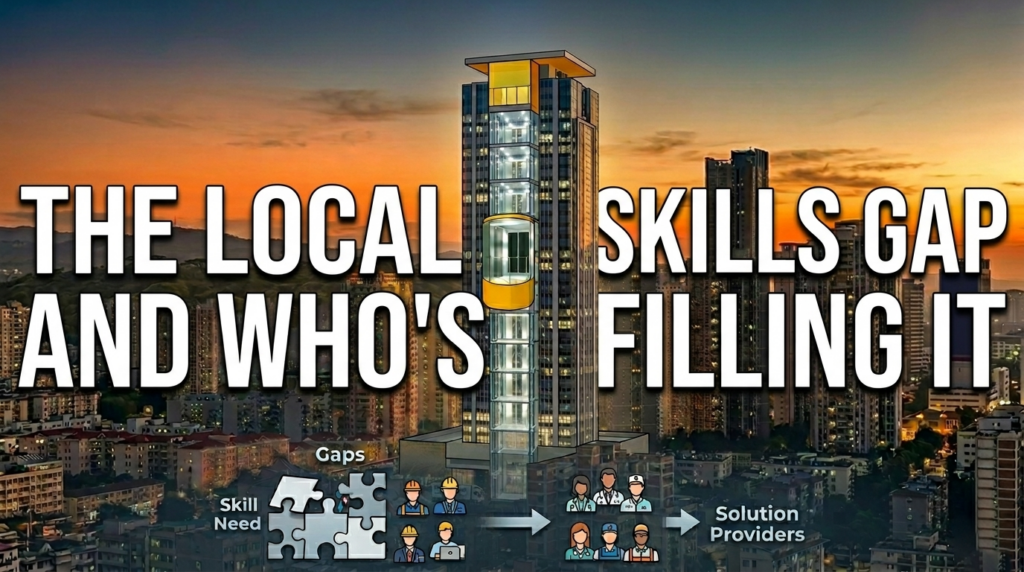
For years, much of Kenya’s elevator servicing landscape was characterised by small, fragmented outfits useful for basic callouts, but lacking the engineering depth, spare parts inventory, or round the clock responsiveness that modern high rises require. As buildings have grown taller and more technically sophisticated, that gap has become harder to ignore. Developers, facilities managers and building owners increasingly need a partner that can handle the entire lifecycle of a lift sales and specification, installation, maintenance, emergency breakdown response, and eventual modernisation rather than stitching together multiple vendors for each stage.
ZM Engineering Limited has spent close to a decade building exactly that kind of full spectrum capability in the Kenyan market.Operating across Nairobi and key counties, the company has grown into a homegrown focused elevator specialist offering end to end services: elevator sales, site installation, breakdown repairs, scheduled routine maintenance, and modernisation of ageing lift systems.
What distinguishes ZM Engineering from the smaller artisan style operators that still dominate parts of the market is structure. The firm employs a permanent team of factory trained, Kenyan based certified technicians and engineers not subcontracted labour assembled per job backed by an in house spare parts warehouse designed to cut the lead times that typically leave a stuck lift out of service for weeks while components are imported. It also runs a 24 hour emergency breakdown callout service, a feature built specifically around Kenya’s fluctuating power conditions and climate, where delays in response can mean a building’s vertical transport is offline for an extended, costly period.
Over nearly ten years of operation, the company has built a client portfolio exceeding 200 partners, spanning government parastatals, Chinese invested enterprises, local real estate developers, hospitality operators and institutional clients a spread that reflects just how broadly the demand for reliable vertical transport now extends across Kenya’s economy.
A Track Record Written Into Nairobi’s Skyline
ZM Engineering’s project list reads like a tour of Kenya’s most recognisable developments. The company has handled elevator work at the GTC Tower in Westlands at 184 metres and 43 floors, the tallest office tower in East Africa and the anchor of the wider Global Trade Centre complex. Its portfolio also includes the Kenyan premises of the Confucius Institute, the Accord Hotel near Jomo Kenyatta International Airport, Coloho Mall (developed by China Wuyi), Nyayo National Stadium, and Kenya’s Parliament Buildings projects spanning commercial, hospitality, civic and sporting infrastructure.
Beyond the landmark institutional work, the firm has carried out full elevator supply, installation and ongoing maintenance contracts for a string of prime mixed use and residential developments, including Capital Rise, Enzi Heights, Mideya One, Soho Apartment, Atura and Escada upscale towers and boutique residential blocks concentrated in Nairobi’s CBD and its affluent surrounding suburbs. It’s a portfolio that tracks closely with where Kenya’s construction capital has actually been flowing:premium residential, mixed use commercial, and high footfall public infrastructure.
Quote of the Day
“I’m always fascinated by the elevator. You get in, you press a button, and you go to another world.” — David Lynch
Where the Industry Goes From Here
The next phase of Kenya’s vertical transport story will likely be defined by three forces. First, geography: as construction activity decentralises toward Mombasa, Kisumu and other secondary hubs, elevator specialists with genuine national reach not just Nairobi coverage will have an edge. ZM Engineering has already begun extending its service footprint in that direction.
Second, retrofitting: a meaningful share of Kenya’s existing high rise stock now has lifts old enough to need modernisation rather than simple maintenance a market opportunity that runs parallel to new construction.
Third, smart and energy efficient systems: as Kenya pursues its renewable energy targets and developers face rising power costs, IoT enabled elevators with predictive maintenance capabilities and lower energy draw are shifting from a nice to have to a genuine differentiator for new builds.
Kenya’s skyline is going to keep climbing that much is clear from the cement numbers, the credit growth, and the cranes visible from almost any rooftop in Nairobi. The buildings will get taller, the residential towers more numerous, the mixed use complexes more ambitious. But none of that growth means anything if the people inside those buildings can’t move through them safely and reliably. Vertical transport isn’t the part of the construction boom that makes headlines. It’s the part that decides whether the boom actually works.