
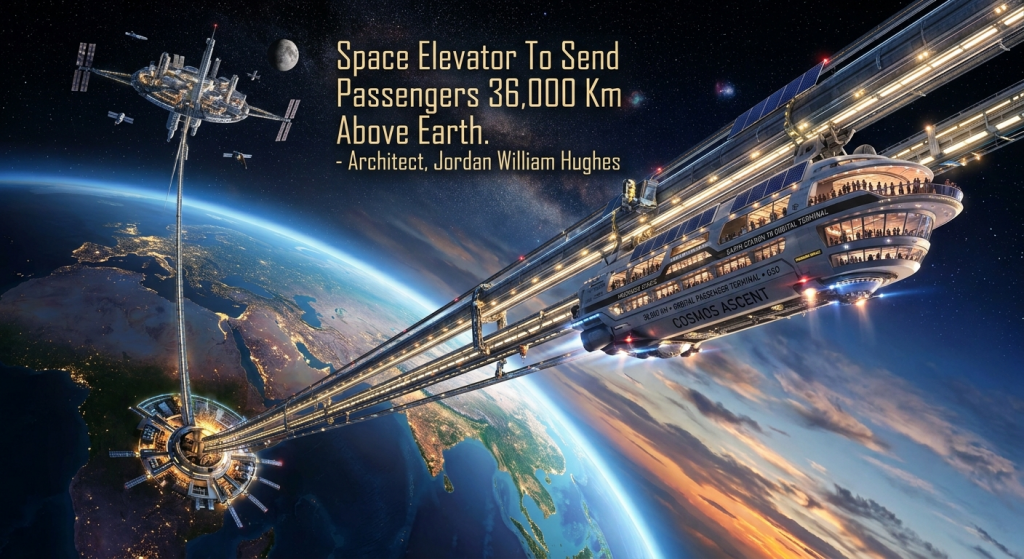
”Project Ascensio” by architect Jordan William Hughes, a concept artist at Foster + Partners, which won the 2023 Architecture and Innovation for Space Grand Prix at the Jacques Rougerie Foundation awards. Here’s an article based on verified reporting:
Architect Jordan William Hughes Designs Space Elevator to Send Passengers 36,000 km Above Earth
British architect and concept artist Jordan William Hughes has unveiled a striking vision for the future of space travel: an ocean-launched space elevator designed to ferry both passengers and cargo far beyond Earth’s atmosphere, replacing the rockets that have dominated space access for decades.
The Concept: Project Ascensio
Dubbed “Project Ascensio,” the design imagines a future where advances in material science and technology make possible a space elevator that is both multipurpose and lightweight. Rather than blasting off from a traditional launch pad, the system would combine an ocean-based spaceport with cables anchored to an asteroid held in geostationary orbit.
The design connects the depths of the ocean to the vastness of space, envisioning a journey between a sea based spaceport and a multi use space station. A captured asteroid in geostationary orbit would serve as the counterweight, connected to Earth by a robust tether lowered from the asteroid itself. Small drone like climbers would then ascend and descend along that tether, carrying people and cargo between the sea-level spaceport and a space station situated more than 26,000 kilometres above Earth roughly the altitude of geostationary orbit, where the reported figures for the project cluster (closer to 26,000 km than 36,000 km, per available coverage).
Why the Ocean?
Placing the spaceport at sea isn’t just for visual drama. The floating structure would be mounted on a ship-like platform capable of moving around the ocean to stay aligned beneath the orbiting counterweight, offering flexibility that a fixed, land based terminus couldn’t match while sidestepping many of the geopolitical and logistical constraints of a traditional spaceport.
Rethinking Rockets
Hughes has framed the project as a direct response to the shortcomings of rocket-based launch systems, which he considers inefficient, costly, and environmentally damaging. Speaking to Designboom, Hughes argued that a space elevator could offer a far more cost-effective alternative to rockets for reaching orbit.
Who Is Jordan William Hughes?
Hughes is a 30 year old architect originally from Barrow, England, now working as an architect in London and as a concept artist at the British architecture studio Foster + Partners. He developed the Ascensio concept in his own spare time, outside his day to day professional work.
Recognition
The design was named winner of the 2023 Architecture and Innovation for Space Grand Prix, awarded by the Jacques Rougerie Foundation, earning Hughes a €10,000 prize. The award was presented at the Jacques Rougerie International Competition in Paris, France.
A Long Road Ahead
Hughes is candid about the scale of the challenge. He acknowledges that developing a material strong enough for the tether remains a major unsolved problem, and the required infrastructure spaceports, cables, and the counterweight system would demand enormous investment and time to construct. Still, Hughes remains optimistic about the long term transformative potential of the idea, describing lightweight construction, mobility, and improved safety as features he believes will define space elevators of the future.
Notably, Hughes has emphasized that the conceptual artwork for the project was produced without the use of AI a point he’s made a distinguishing feature of the work in an era when AI generated concept art has become increasingly common.
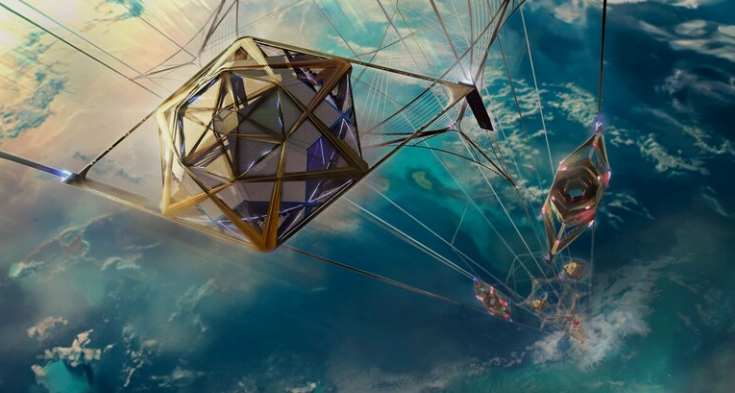
An architect from Cumbria, England, has revealed his ambitious plans to build a space elevator capable of transporting humans to space. Called Ascensio, the elevator is comprised of a long cable tethering an asteroid trapped in geosynchronous orbit to a floating platform back on Earth. According to the BBC, architect Jordan William Hughes won a prize of 8,617 pounds (Rs 909,926) earlier this month from the Jacques Rougerie Foundation, in Paris, for his innovative design. Mr Hughes said the idea may be fanciful today but he believes space elevators will be used in the future.
He said he designed the elevator to replace rockets, saying they are inefficient, expensive and bad for the environment.
“It would revolutionise the way we get to and from space and make it more viable,” the architect told the BBC.
Will this idea become a reality?
Mr Hughes said the idea has been around for some time but won’t become a reality soon.
“This would be a very expensive, very ambitious project and it’s not something I’m expecting to be built in the next 10 years.