
A practical resource for property developers, project managers, and investors building vertically in Nairobi’s fast-growing skyline.
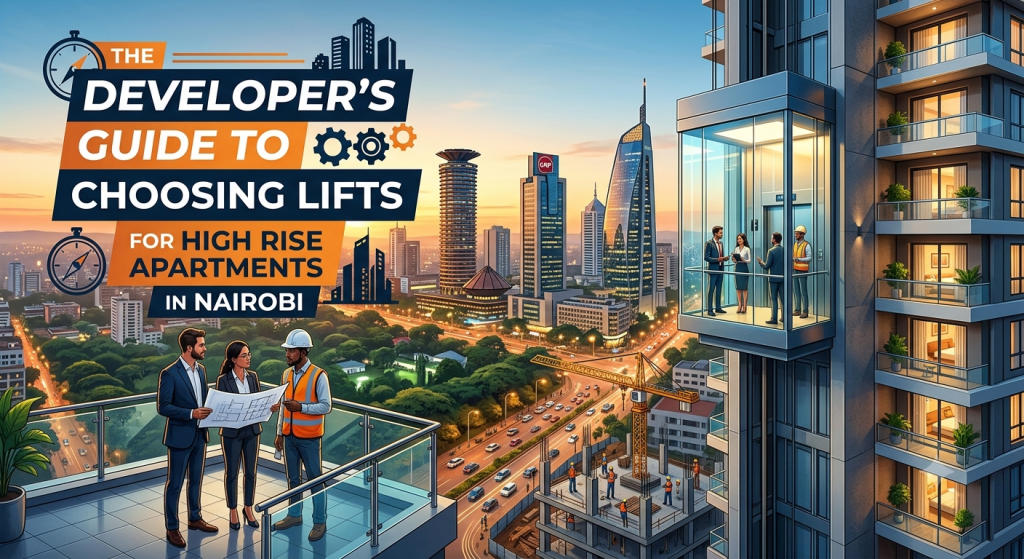
Introduction: Why Your Lift Choice Can Make or Break a Development
Nairobi’s residential skyline is rising fast. From Kilimani and Kileleshwa to Upper Hill, Ruaka, and Athi River, developers are building taller to meet demand for high density housing on limited land. But as buildings climb past six, ten, or twenty storeys, one system quietly determines whether that investment succeeds or struggles: the lift.
A well-specified lift system protects resale value, keeps tenants happy, and avoids the maintenance headaches that plague poorly planned installations. A poorly chosen one becomes a recurring cost center, a source of tenant complaints, and in the worst cases, a safety liability.
This guide walks developers through the key decisions involved in specifying lifts for high rise apartment projects in Nairobi from load calculations to power backup, local compliance, and long-term maintenance planning
1. Start With Traffic Analysis, Not Catalogue Browsing
The single biggest mistake developers make is choosing a lift model before calculating actual traffic demand. The right lift depends on:
- Number of floors and units per floor — A 12-storey building with 4 units per floor has very different peak hour demand than the same height with 2 units per floor.
- Expected occupancy density — Family apartments, studios, and serviced apartments generate different usage patterns throughout the day.
- Peak traffic periods — Morning departure rush and evening return rush are the two windows that determine whether one lift is enough, or whether you need two or more running in parallel.
As a rule of thumb, buildings above eight floors with more than 20-25 units typically need at least two passenger lifts to keep wait times reasonable. Developers who under specify at this stage often find themselves retrofitting a second shaft later a far costlier exercise than planning for it during design.
2. Match Lift Type to Building Height and Use Case
Not all lifts are built the same way, and the right technology depends heavily on your building’s height and shaft configuration.
Machine Room Less (MRL) Traction Lifts
The standard choice for most mid to high rise residential buildings in Nairobi today. They eliminate the need for a separate machine room, saving valuable rooftop space a real advantage on constrained urban plots. Energy efficient and well-suited for buildings from roughly 5 to 20+ storeys.
Hydraulic Lifts
Better suited to low-rise buildings (typically up to 4-6 floors) where shaft height is limited. They’re slower and less energy-efficient over longer travel distances, making them a poor fit for true high-rise developments.
Gearless Traction Lifts
Necessary for taller towers and higher speed requirements, offering smoother rides and better energy performance at scale. Worth considering for premium developments above 15-20 floors, or where fast, high frequency service is a selling point.
Developer takeaway: if you’re building beyond six floors, MRL or gearless traction systems will almost always outperform hydraulic options on both cost per year and tenant experience.
3. Plan for Nairobi’s Power Reality
This is where many otherwise well designed developments fall short. Power interruptions are still a factor in Nairobi’s built environment, and a lift stranded mid shaft during an outage is more than an inconvenience it’s a genuine safety concern, particularly for elderly residents, children, and people with mobility needs.
When specifying your lift system, insist on:
- Automatic Rescue Devices (ARD) that bring the lift safely to the nearest floor and open the doors during a power failure, without requiring manual intervention.
- Compatibility with backup generators or solar-battery systems, especially for developments that already include standby power for other building systems.
- Voltage stabilization, since fluctuating power supply can accelerate wear on lift motors and control systems over time.
Building this into your specification from day one is significantly cheaper than retrofitting it after handover and it’s increasingly what discerning tenants and buyers expect as standard.
4. Factor in Nairobi’s Climate and Site Conditions
Local conditions matter more than generic manufacturer specs suggest:
- Dust and altitude — Nairobi’s altitude and dusty conditions during dry seasons can affect ventilation systems and component wear. Lifts specified for coastal or temperate climates may need adjusted maintenance schedules here.
- Construction quality of the shaft — Lift performance depends heavily on shaft plumb accuracy and finishing. Poor shaft construction is one of the most common causes of installation delays and post-handover snagging in Nairobi developments.
- Coordination with the main contractor — Lift suppliers need shaft dimensions, pit depth, and headroom confirmed early in the construction program, not at finishing stage. Late coordination is a leading cause of costly rework.
5. Understand Compliance and Safety Standards
Lifts in Kenya fall under building code and occupational safety requirements that developers must factor into project timelines:
- Lifts require inspection and certification before occupancy, typically involving structural, mechanical, and electrical safety checks.
- Regular statutory inspections continue after handover a maintenance contract should account for this from the outset, not be arranged reactively.
- Developers should request full documentation (certificates of compliance, installation records, warranty terms) from their supplier as part of the handover package, both for buyer confidence and for eventual resale or refinancing due diligence.
A reputable local supplier will manage this process alongside you rather than leaving it as an afterthought.
6. Don’t Underestimate the Maintenance Relationship
The purchase price of a lift is only part of the cost picture. What determines long term value is the maintenance relationship that follows.
Questions worth asking any prospective supplier before signing:
- Do they carry spare parts locally, or is every repair dependent on imports and long lead times?
- What is their average response time for breakdown callouts in your specific part of Nairobi?
- Do they offer preventive maintenance contracts, or only reactive repairs after something fails?
- Can they provide references from other developments of similar scale?
A lift that’s cheap to install but expensive or slow to maintain will cost a developer far more over a 15-20 year building lifecycle both in direct spend and in tenant satisfaction, which directly affects occupancy rates and unit resale value.
7. A Quick Specification Checklist
Before finalizing your lift order, confirm:
- Traffic analysis completed for peak hour demand
- Lift type matched to building height and shaft design
- Number of lifts sufficient for unit count and floors
- Automatic Rescue Device included for power outages
- Compatibility confirmed with backup power system
- Shaft dimensions and pit depth coordinated with contractor early
- Compliance and inspection process planned into project timeline
- Maintenance contract terms and local spare parts availability confirmed
- Full documentation included in handover package
Building in Nairobi? Get It Right From the Shaft Up
Choosing the right lift system isn’t just an engineering decision it’s a decision that shapes tenant satisfaction, building reputation, and long term asset value.
ZM Engineering Limited works with developers, project managers, and property owners across Nairobi to supply, install, and maintain elevator systems built for local conditions from initial traffic analysis through statutory certification and ongoing maintenance support.
If you’re planning a high rise residential development and want lift specifications reviewed before you commit, get in touch:
 +254 798 111 666
  [email protected]
ZM Engineering Elevating Nairobi’s skyline, one building at a time.